Why we built IsoLedger
Every safety procedure looks solid on paper. That is exactly the problem: on paper.
Anyone who has worked on industrial electrical installations knows the ritual. A work permit gets printed, signed, and put in a folder. Someone locks out a switch, hangs a tag, and writes it down. It works, until the day it doesn’t. The permit is illegible, or lost, or filled in after the fact. The person who knew how it all fit together retired last year. And nobody can say with certainty which board was actually locked out, or when, or by whom.
We built IsoLedger because that gap is not a paperwork nuisance. It is a safety risk.
Two problems, one system
The first problem is proof. A lock-out/tag-out procedure is only worth something if you can show, afterwards, that every step was taken in the right order by the right person. Paper cannot really do that. A digital record with a signature and a timestamp on every step can. That is the boring, essential half of IsoLedger: the Golden 8, enforced and documented, so an audit becomes a formality instead of three days in the archive.
The second problem is the one that keeps people up at night, and it is the one paper can never solve.
Nobody knows what hangs below anymore
Industrial installations are not designed once and left alone. They grow. Over twenty years, boards get added, feeders get rerouted, a sub-panel gets tapped for “just one more thing.” The single-line diagram on the wall stops matching reality. The knowledge that used to fill the gap lived in one experienced person’s head, and that person is gone.
So you lock out a board to work on it safely, and you genuinely do not know everything that goes dark with it. Most of the time that is fine. And then one day it isn’t.
You only want to hear about that sump pump before the basement floods, not after.
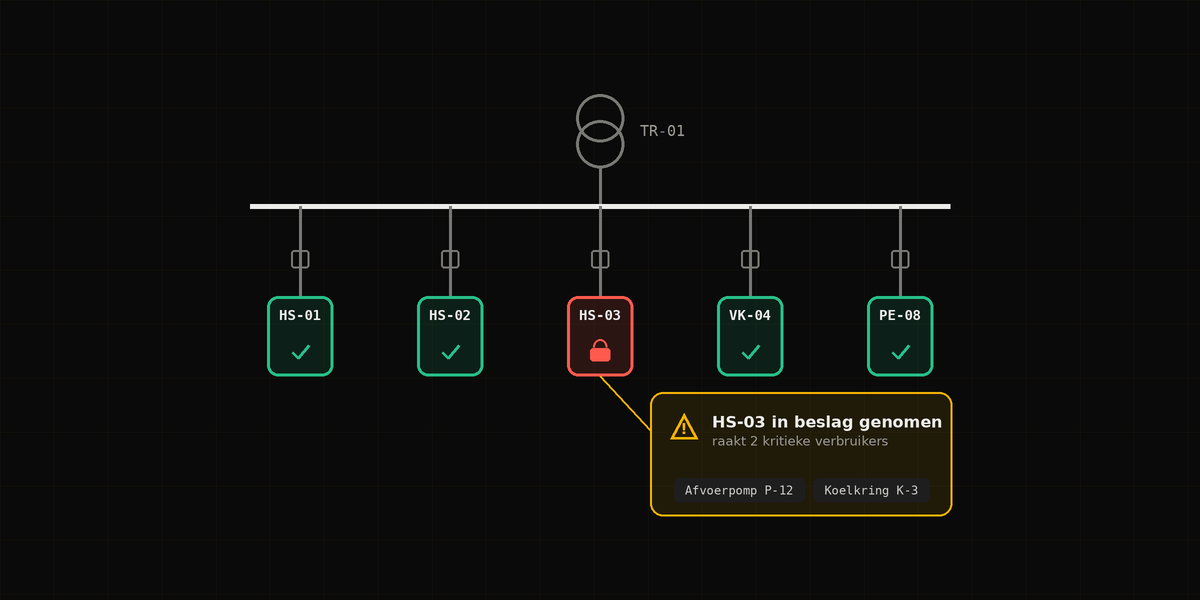
That is the moment we kept coming back to. Not the dramatic accident, but the quiet, expensive surprise: a cooling circuit, a drainage pump, a process you forgot was fed from that exact board. The lockout was done correctly. The overview was simply lost.
What we actually built
IsoLedger keeps a live model of the installation: the transformer, the boards, the feeders, the consumers, and how they connect, including boards fed from more than one side. Because the system knows what hangs below every board, it can work out what a lockout will take down with it. When a critical consumer is affected, you get a warning before the permit is approved, not after the line stops.
In other words, the model becomes the shared memory the installation lost. It is the one place where the picture is still correct, and it warns you before you switch off something you did not mean to.
Getting your installation into that model is deliberately easy. If it already exists in Caneco, you import it in one step. If it doesn’t, we build it for you.
Where this comes from
IsoLedger is built by Lightstream, the team behind Cabinet Manager. We have spent years close to technical installations and the people who keep them running, and we kept seeing the same two gaps: proof that doesn’t hold up, and an overview that quietly disappears. IsoLedger is our answer to both.
This is the first of what we hope will be many pieces here. We will share use cases, practical notes and whitepapers on working safely and demonstrably with electrical installations. Thanks for reading the first one.
Elke veiligheidsprocedure ziet er op papier sluitend uit. En dat is nu net het probleem: op papier.
Wie aan industriële elektrische installaties werkt, kent het ritueel. Een werkvergunning wordt afgedrukt, ondertekend en in een map gestoken. Iemand vergrendelt een schakelaar, hangt er een kaart aan en noteert het. Het werkt, tot de dag dat het niet werkt. De vergunning is onleesbaar, of zoek, of achteraf ingevuld. De persoon die wist hoe alles samenhing, ging vorig jaar met pensioen. En niemand kan met zekerheid zeggen welk bord effectief in beslag was, of wanneer, of door wie.
We bouwden IsoLedger omdat dat gat geen administratieve last is. Het is een veiligheidsrisico.
Twee problemen, één systeem
Het eerste probleem is aantoonbaarheid. Een lock-out/tag-out-procedure is maar iets waard als je achteraf kan tonen dat elke stap in de juiste volgorde door de juiste persoon werd gezet. Papier kan dat niet echt. Een digitale registratie met een handtekening en een tijdstempel op elke stap wel. Dat is de saaie, essentiële helft van IsoLedger: de Gouden 8, afgedwongen en gedocumenteerd, zodat een audit een formaliteit wordt in plaats van drie dagen in het archief.
Het tweede probleem is het probleem dat mensen wakker houdt, en het is er een dat papier nooit kan oplossen.
Niemand weet nog wat er onder hangt
Industriële installaties worden niet één keer ontworpen en dan met rust gelaten. Ze groeien. Over twintig jaar komen er borden bij, worden vertrekken omgelegd, wordt een onderbord afgetakt voor “nog één ding”. Het eendraadschema aan de muur stemt niet meer overeen met de realiteit. De kennis die dat gat opvulde, zat in het hoofd van één ervaren iemand, en die is weg.
Dus je neemt een bord in beslag om er veilig aan te werken, en je weet oprecht niet alles wat er mee uitvalt. Meestal is dat geen probleem. En dan op een dag wel.
Je wil van die afvoerpomp horen vóór de kelder onder water staat, niet erna.
Dat is het moment waar we telkens op terugkwamen. Niet het dramatische ongeval, maar de stille, dure verrassing: een koelkring, een afvoerpomp, een proces waarvan je vergeten was dat het net van dat bord gevoed werd. De inbeslagname was correct uitgevoerd. Het overzicht was gewoon zoek.
Wat we effectief gebouwd hebben
IsoLedger houdt een levend model van de installatie bij: de transformator, de borden, de vertrekken, de verbruikers, en hoe ze verbonden zijn, inclusief borden die langs meerdere kanten gevoed worden. Omdat het systeem weet wat er onder elk bord hangt, kan het berekenen wat een inbeslagname mee uitschakelt. Wordt een kritieke verbruiker geraakt, dan krijg je een waarschuwing vóór de vergunning wordt goedgekeurd, niet nadat de lijn stilvalt.
Met andere woorden: het model wordt het gedeelde geheugen dat de installatie kwijt was. Het is de ene plek waar het beeld nog klopt, en het waarschuwt je vóór je iets afschakelt wat je niet bedoelde.
Je installatie in dat model krijgen, is bewust eenvoudig. Bestaat ze al in Caneco, dan importeer je ze in één stap. Zo niet, dan bouwen wij ze voor je.
Waar dit vandaan komt
IsoLedger wordt gebouwd door Lightstream, het team achter Cabinet Manager. We staan al jaren dicht bij technische installaties en de mensen die ze draaiende houden, en we zagen telkens dezelfde twee gaten: aantoonbaarheid die niet standhoudt, en een overzicht dat stilaan verdwijnt. IsoLedger is ons antwoord op beide.
Dit is de eerste van hopelijk vele stukken hier. We delen use cases, praktische inzichten en whitepapers over veilig en aantoonbaar werken aan elektrische installaties. Bedankt om de eerste te lezen.